 Douro Valley Wine Tour
Getting to the Douro Valley from Porto on Your Own: Train Times, Taxi Traps, Real Costs
Getting to the Douro Valley from Porto looks simple on a map and rarely is. Everyone plans the day trip and then hits the same wall: the valley is about 2.5 hours from Porto by train, taxis out there are scarce and the true costs are murkier than any listing admits. This guide lays out the four real routes with exact train times, the taxi situation nobody explains properly and honest all-in numbers, so you can choose between going solo and booking a day with open eyes.
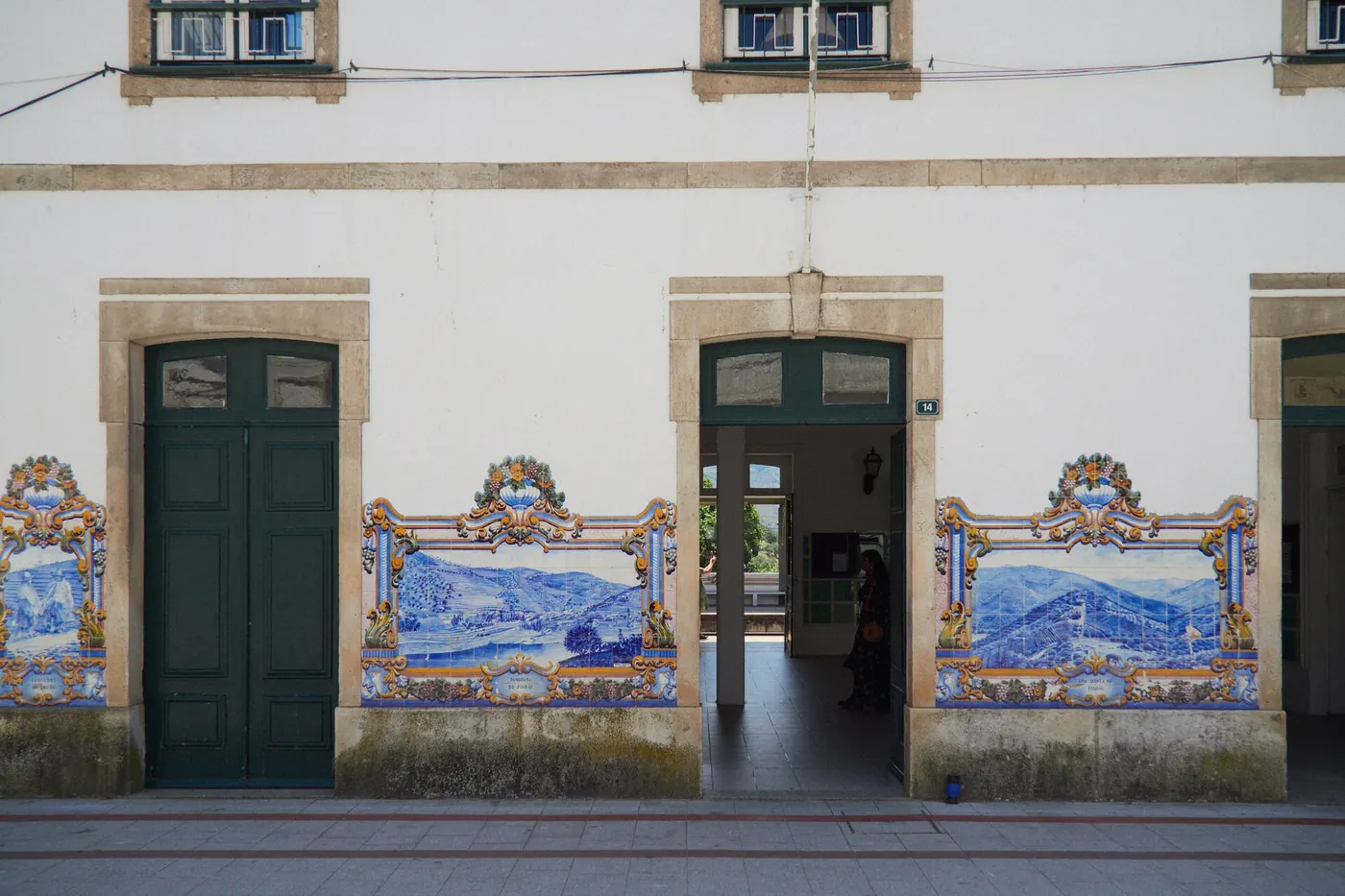
Pinhão station, where the azulejo panels are better known than the village around them. Photo: lumoplank, CC0, via Wikimedia Commons.
Quick answer Yes you can do it alone, and the time math decides everything
Going to the Douro Valley from Porto without a car or a guide works, if you accept the arithmetic first. The train to Pinhão takes about 2.5 hours each way, so the 09:20 from São Bento arriving around 11:45, paired with the 18:14 return, leaves roughly 4.5 usable hours on the ground after lunch and the boat cruise. That is one winery done properly. A realistic DIY day costs 66-105 EUR once tastings, the boat and lunch are added, which narrows the gap to a guided tour more than most people expect.
Key takeaways
- Target the IR around 09:20 from São Bento, arrive Pinhão about 11:45, and aim for the 18:14 back. Verify times on cp.pt first
- A partial bus replacement has been running on the Caíde to Régua section for track works, with trains covering Régua to Pinhão
- No Uber and no Bolt in Pinhão or Régua, with roughly 2 to 4 taxis serving both towns. Pre-arrange drivers through your quinta, restaurant or hotel
- Walkable from Pinhão station: Quinta do Bomfim 5 minutes east, Quinta da Foz by the river, Quinta das Carvalhas 15-20 minutes uphill
- Sit on the right heading east for the river views and the left on the return. The guided version uses the same railway
First, Be Honest About the Time Math
Before any route decision, do this arithmetic, because it is the thing travellers consistently get wrong. The Douro is not Sintra. Nobody pops over and back.
The 4.5-hour window
The train from Porto to Pinhão, the main DIY destination in the valley, takes roughly 2 hours 30 minutes each way. Take the recommended 09:20 departure from São Bento and you arrive around 11:45. The last return that leaves any comfort margin is the 18:14. That is a window of about 6.5 hours on the ground, and subtracting an hour of lunch and the one-hour boat cruise most people want leaves roughly 4.5 hours for winery visits, walking and everything else.
That is enough for one winery visit done properly, or two done quickly if both are pre-booked and neither requires a taxi. A Douro-based sommelier puts the same number another way: "The ride from Porto to Pinhão takes about 2.5 hours, so on a day trip you'll spend around 5 hours on the train," says Polina, a WSET Level 3 sommelier working in the valley.
Day trip versus one overnight
The table below sets the two formats against each other, using the planning assumptions local guides and forum reports converge on for a Pinhão-based visit.
| Measure | Day trip by train | One overnight | What it changes |
|---|---|---|---|
| Time on the ground | About 4.5 hours | 1-2 full days | The single biggest factor in the whole trip |
| Wineries realistically | 1-2, walking distance | 4-6, with car or taxi days | Overnights unlock the quintas the day tripper skips |
| Boat cruise | Yes, the 1-hour loop | Yes, multiple options | Both formats get the cruise |
| Stress level | High if unplanned | Low | Preparation replaces luck |
| Best for | Budget travellers and train lovers | Almost everyone who can manage it | One night transforms the experience |
When the overnight stops being optional
Stay a night in Pinhão or Régua, even one, and the whole shape of the trip changes: the valley after the day-trippers leave, wineries at your own pace, no clock to watch. During harvest season in September and October it shifts from nice to nearly essential, because the evening light on the terraces and the activity at the quintas after 17:00 are what people actually remember. The harvest guide covers what happens after dark in that window.
That said, a well-planned day trip is absolutely worth doing. You just need to know what you are working with before boarding.
The Four Routes, Matched to Who You Are
Most guides present the transport options as a neutral menu. They are not neutral. Each route fits a different traveller, and the costs below are the honest all-in figures for a day, not teaser rates.
Route A: train plus walking-distance wineries
The budget-independent option. It works well for solo travellers, for people who enjoy train journeys as part of the experience, and for anyone happy to plan ahead. You take the train, walk to the quintas close to Pinhão station, have one winery visit booked in advance, do the short boat cruise and catch the return train. A taxi is optional, only needed to reach beyond the walkable estates. It is genuinely possible to have a complete day without one.
The all-in figures for the day, compiled from local operator pricing and traveller reports: return train ticket 10-15 EUR, winery tasting 15-25 EUR, the one-hour boat cruise 11-15 EUR, lunch 20-30 EUR, optional taxi 5-10 EUR each way. Total: roughly 66-105 EUR per person, and that covers one winery.
Route B: train in, boat back
The itinerary variety seekers want. Morning train to Pinhão, the day at wineries and the river, then an afternoon rabelo boat returning downriver toward Porto. Operators such as Douro Azul run this type of downstream service from Pinhão, with afternoon departures typically between 14:00 and 16:00, to be confirmed directly when booking. In the April to October high season, book at least a week ahead, because afternoon departures sell out.
One clarification worth its own sentence: this is not the full-day upstream cruise from Porto, which is a separate specialist product taking 8 to 10 hours one-way, not a same-day return. The hybrid costs 30-60 EUR for the boat leg depending on operator and duration, and it hands you two completely different views of the valley, the railway hugging the river from above and the water-level perspective on the way back.
Route C: rental car with a designated non-drinker
The most flexible option, and only viable if one person in the group genuinely is not drinking. The valley roads, particularly the N222 between Régua and Pinhão, are narrow, winding and demanding, and they are also spectacular. A car reaches quintas that are impossible by public transport, stops at viewpoints on your schedule and opens up remote villages.
The seasonal caveat: in wet weather from November through February the N222 becomes significantly more demanding, with tight blind corners and surface water on the sections cut into the cliff face. Factor that into a winter visit. Rental from Porto runs about 40-70 EUR per day before fuel and tolls, and the drive from Porto to Pinhão takes about 1 hour 45 minutes. As one local guide puts it, "You really shouldn't drink and drive!" No designated driver, no Route C.
Route D: small-group wine tour from Porto
The option every other article pushes from the first paragraph. It sits fourth here not because it is worse, in many cases it is better, but because it deserves honest positioning rather than a default recommendation. A good small-group day handles transport, winery reservations, the lunch booking and the boat cruise, and it reaches wineries that are genuinely inaccessible without a vehicle. For drinking freely at multiple estates, it is the only realistic option.
Local pricing runs from about 110 to 170 EUR per person all-inclusive. Two checks matter more than the rest: the group cap, since "small group" can legally mean 25 and the good ones cap at 8-12, and the route, because cheaper operators take the A4 motorway instead of the scenic N222 and passengers expecting vineyard views report real disappointment. The days that pass both checks are compared on the tour lineup, and the benchmark full day with two wineries, a cellar lunch and the cruise is the one to measure the rest against.
All four routes side by side
The full comparison, with per-person costs compiled from the route math above and published operator pricing for the Porto to Douro run.
| Route | Cost per person | Wineries accessible | Drink freely? | Best for |
|---|---|---|---|---|
| Train, solo | 66-105 EUR | 1-2, walking distance | Yes | Budget travellers and independence |
| Train + boat hybrid | 80-115 EUR | 1-2, plus the river view | Yes | Variety seekers |
| Rental car | 50-80 EUR split | Unlimited | Driver only | Groups with a designated driver |
| Small-group tour | 130-170 EUR all-in | 2-3, curated | Yes | First-timers and tasting days |
The cost gap, stated plainly
Once train, tasting, boat, lunch and a single taxi are added up, the DIY day lands at 66-105 EUR per person. A small-group tour starts around 110-130 EUR and includes all of those elements. Forum contributors who have done both make the point directly: "Doing it on your own will cost almost as much as the cheaper bus tours from Porto once you factor everything in," as one Rick Steves Travel Forum regular put it.
That does not mean the tour is always better. It means the budget argument for going solo is weaker than most people assume going in.
Going Solo by Train
The honest ledger for the route most DIY travellers actually take.
What we genuinely like
- The railway ride is part of the pleasure, with roughly 2.5 hours of river and terrace scenery each way
- Access to small, family-run quintas that never appear on group tour itineraries
- The cheapest realistic day in the valley at 66-105 EUR all-in
- Nobody else's schedule: the timetable is the only clock
The honest downsides
- About 5 hours of the day are spent on the train
- One or two wineries is the realistic ceiling, and both need advance booking
- Taxis are scarce enough that every beyond-walking-distance move must be pre-arranged
- The last comfortable return leaves Pinhão at 18:14, which compresses the afternoon
Who it's NOT for: Groups who want to taste freely at two or three estates and see the elevated N222 viewpoints. That day needs a vehicle with someone else driving, which is what the guided routes in the comparison above provide.
The Train Route: Every Operational Detail
If the train is the route, this is everything worth knowing before leaving the hotel, from which platform to which seat, with the current works on the line flagged.
Which station to use
Both São Bento and Campanhã connect to the Douro line. São Bento sits in central Porto inside a famous azulejo-tiled hall, with fewer daily departures but more convenience for most visitors. Campanhã is the larger hub slightly east of centre, with more options and the origin of some connections.
Check departures from both on cp.pt before committing to one.
Train types decoded
Three categories run the line. U (Urbano) trains are local stoppers, very slow beyond Marco de Canaveses. R (Regional) trains go further and call at the major stations including Régua and Pinhão. IR (InterRegional) trains are the fastest, skipping the small stops, and they are the right pick for a day trip.
Some trips to Pinhão require a transfer, typically from a U or R service at Caíde or Marco de Canaveses onto an IR or R train. It is not difficult, but it is confusing if you did not know to expect it.
The works on the line
A partial bus replacement has been operating between Caíde and Régua for infrastructure work, with full train restoration expected around April 2026. The Régua to Pinhão section continues to run by train. Before travelling, check the current pattern on cp.pt and do not rely on cached timetables or older blog posts.
The day-trip sequence
The IR departure around 09:20 from São Bento reaches Pinhão around 11:45, and that is the target train. Earlier departures exist but require connections, and later ones compress the day significantly. The last return that gives you breathing room is the 18:14 from Pinhão.
If the winery visit finishes by 16:30, an earlier departure beats the peak crowd on the 18:14.
Tickets and the app
Buy on cp.pt, on the CP mobile app or at the station. The app runs in Portuguese and English, works reliably once set up, and stores tickets for offline use, which matters because signal drops along the line. Paper tickets do not need validation before boarding.
Two habits worth copying from experienced travellers: buy the ticket the night before to skip the morning rush, and buy the return in Porto, because the queue at Pinhão station before the evening train is real and you do not want to be standing in it with a departure closing in.
Where to sit and what to bring
Sit on the right side heading east toward Pinhão. Views improve dramatically after Caíde, and the stretch between Régua and Pinhão, where the line runs essentially at river level with terraced vineyards rising on both sides, is the section everyone photographs. Move to the left side for the return. There are no automated announcements on many Douro line trains, so keep an offline map open and track your position.
There is nothing to buy on board and no food service. Bring water, snacks and a power bank, since mobile signal along the gorge sections is intermittent and sometimes nonexistent. Bring cash too, at minimum 50 EUR. One traveller's warning covers it: "Don't forget Euros. There was nowhere to exchange money once I left Porto, and very few places took credit cards," reports Alice's Adventures on Earth.
One last distinction: CP runs a seasonal historic tourist train on select weekends with vintage panoramic carriages. It is a separate bookable product, not the standard IR service a day trip uses.
Pinhão: What Is Actually Here and What Is Not
Travellers arriving from the photographs expect more town than there is. The landscape is everything promised. The village is one main street, a handful of restaurants and a station far more charming than its surroundings.
The station and the boat
Arrive a little early anyway: the azulejo tile panels wrapping the station exterior depict grape picking, rabelo boats and the harvest, and 15 minutes covers the walk around them.
The boat pier sits a short riverside walk from the platform, with most operators within 5 minutes of the exit and several rabelo boats lined up along the embankment. The one-hour cruise travels upriver through the terraced landscape and back, some versions with a glass of port and narration, some plain sightseeing, so check what is included. Tickets run about 11-15 EUR for the hour, with a two-hour option also available. Morning before noon is the best slot, when light hits the south-facing terraces and the river is calmer. In high season, April to October, buy ahead because operators fill up, and in winter, November to March, services run reduced or sometimes suspended, so confirm before building the day around the cruise.
Wineries within walking distance
Three estates work on foot from the station.
Quinta do Bomfim is the closest, about 5 minutes east, and the most popular independent-traveller target in the valley. It is a Symington family property running structured tours at fixed time slots, and those slots can be fully booked by mid-morning in peak season. Book one to two weeks ahead in spring and autumn, four to six weeks ahead during harvest, and never take the last slot of the day if the 18:14 is the plan. Travellers work around the train too: "We went there first and switched the winery tour to 15:30, which gave us more time to enjoy our Port Wine at the end," one travel-forum visitor explains.
Quinta das Carvalhas is 15-20 minutes on foot including a steep uphill section, manageable but not trivial in summer heat. Unlike most quintas it sometimes allows walk-in tastings by the glass, a genuinely rare option in the region, but call ahead to confirm rather than showing up and hoping.
Quinta da Foz is the intimate one, close to the river with a family-winery feel and tastings with vineyard views. Smaller quintas keep variable schedules, so check current hours before relying on it.
Wineries worth a taxi
Quinta do Seixo has some of the best elevated views over the river in the region. It is a short taxi ride under 10 EUR, it is a Sandeman property with solid tours, and the move that saves the day is asking winery staff to call your return taxi rather than assuming one will be waiting.
Quinta de la Rosa sits across the bridge on the south bank, about 15 minutes on foot from the station. A small hotel operates alongside the winery, which makes it the natural pick if an overnight is under consideration.
Lunch, and the off-season trap
LBV 79 is the river-view terrace pick, worth confirming open before it becomes a fixed part of the plan, since small Pinhão restaurants keep irregular hours and seasonal closures. The cafés directly across from the station are the reliable fallback in a time crunch.
Now the trap, one of the most commonly cited regrets among independent visitors and one other guides skip. On weekday afternoons in October and November, the majority of Pinhão's restaurants and cafés may be closed or on reduced hours. Travellers have arrived by train in mid-October to find only the station café open. The realistic backups: the quinta wine bars at Bomfim and Seixo, the station café, or food carried from Porto. If the trip falls in that window, pack a proper lunch.
The Taxi Problem, Solved
This is the section most likely to save the day, and the one every other guide skips.
The reality
Between Pinhão and Régua there are somewhere between 2 and 4 functioning taxis at any given time. Uber does not operate here. Bolt does not operate here. This is not a city, and two forum reports say it better than any summary:
"I looked everywhere in Pinhao for a taxi and none were to be found," wrote CWSocial on the Rick Steves Travel Forum in October 2023. Another contributor on the same forum: "There was no Bolt or Uber service in Pinhao. I think there was only two taxi cabs waiting at the Pinhao train station."
Four ways around it
Every one of these works, and the first is the cleanest.
- Pre-arrange through the quinta. When booking the winery visit, which must be done in advance anyway, ask them to recommend a local driver and take the phone number. Ask the winery to call the return taxi at the end of the tour
- Ask the lunch restaurant. Local restaurants keep driver contacts, and staff calling a car for a guest is routine. This has rescued more than one missed afternoon
- Ask the accommodation. Overnight guests can have a host arrange a driver for the following day, which converts the whole problem into a non-issue
- Plan around walking distance only. Bomfim, Foz and Carvalhas are all walkable. Do the boat, have lunch, skip the taxi. The hilltop viewpoints are the trade-off, and a complete, satisfying day is the compensation
The evening train crush
In summer and especially during harvest, the evening trains from Pinhão are crowded, because river-cruise groups and winery visitors all converge on the same departures. Local report: "The trains that depart Pinhão in the early evening will be quite packed, so get there well ahead of time," advises RiA Vistas.
Arrive at the platform 15-20 minutes early. There are no seat reservations on most Douro line services, and standing in the vestibule for 2.5 hours is as uncomfortable as it sounds.
Solo or Tour, Decided
If You enjoy trains as travel, not just as transportation
Go solo. Watching the landscape unspool for 2.5 hours with a coffee and no schedule is the point, not the price of admission.
If You want small family-run quintas that group tours never visit
Go solo and book them directly. The walking-distance cluster around Pinhão station alone justifies the trip.
If Everyone in the group wants to drink freely at multiple wineries
Book a tour. Only someone else driving makes that day possible, and no taxi plan fixes it.
If You have exactly one day and want 2-3 wineries with zero logistics
Book a small-group day that uses the N222, includes lunch and caps the group at 8-12.
If It is your first Douro visit and you want the context
A good guide explains why the terraces face south and what separates a Ruby from a Tawny in production terms. That storytelling is hard to replicate alone.
If You Book a Tour, Check These Five Things
The most common regret among tour-takers is not the experience. It is the fine print nobody read before checkout.
The five-point check
Run every listing against this list before paying, and most bad tour outcomes disappear.
- Maximum group size. "Small group" can legally mean 25 people. Look for caps at 8-12
- The route. Confirm it uses scenic roads, not the A4 motorway, where the views are not the Douro views anyone came for
- Tastings at 2 or more wineries, included rather than optional
- Lunch included, not an add-on at extra cost
- A locally trained or WSET-certified guide, which is what turns a drive into a wine education
Where to go from here
For the private version of the same day, with a driver, a customized route and access to estates that sit outside every standard itinerary, the US booking guide covers what custom days cost and how they are structured. For a taste of the valley without the Porto transfer at all, the Pinhão half day starts in the village itself with a cruise and a Croft cellar visit in three hours.
What Actually Changes by Month
The DIY logistics shift with the seasons more than the tours do. The table pulls together the operating reality for each stretch of the year, from quinta opening patterns to train crowding, based on local guide reporting and forum experience.
Season by season for the independent traveller
Read the right-hand column as the verdict for anyone travelling without a vehicle and without a guide.
| Season | Landscape and crowds | Access notes | Verdict |
|---|---|---|---|
| January to March | Bare vines, dramatic mist, low crowds | Some quintas closed to tourism, reduced train schedule with the Caíde to Régua bus replacement active | Best for solitude. Call quintas ahead |
| April to June | Green, lush, flowering, medium crowds | Everything open and easy to book, full schedule | Best for first-timers |
| July to August | Golden and dry, high crowds, 35-40°C heat | Everything open, midday heat brutal | Go early, avoid midday outdoors |
| September to October | Harvest under way, very high crowds | Book wineries 4-6 weeks ahead, evening trains at their most crowded | The best overall, and the most planning |
| November to December | Autumn colour, then quiet, low crowds | Many quintas closing, boat services reduced | Underrated, atmospheric and peaceful |
The harvest window in particular
September and October are when the terraces are actually worked: people picking, the smell of fermenting grapes and, at the larger quintas, foot-treading lagares in action. It is genuinely worth navigating the logistics for. In this context "book in advance" means 4 to 6 weeks for winery tours, and the evening return trains are the most crowded of the year.
The stage-by-stage detail lives in the harvest guide.
Details Nobody Warns You About
Six small things that each sound minor and each derail a Douro day trip every summer.
The last winery tour slot is a trap
Popular quintas such as Bomfim sell a late-afternoon tour that sounds ideal: morning free for the boat and lunch. In practice, finishing that tour, walking back to the station and boarding the 18:14 leaves no margin for a long tasting, a queue at the wine shop or a slow taxi. Book an earlier afternoon slot and spend the extra half hour on the terrace with a glass instead.
No announcements on the train
This sounds minor until the train is deep in a tunnel section somewhere between Tua and Ferradosa and it is unclear whether the stop has passed. Download an offline map of the Douro region before boarding and keep GPS tracking on. The landscape pulls attention to the window anyway, but knowing the position matters when deciding whether to stay on one more stop.
Pinhão is not a wandering town
A few streets, a handful of businesses. Travellers arriving expecting the charm of a Provençal wine village sometimes feel underwhelmed by the village itself. The appeal is entirely in the surrounding landscape and the quintas, so plan the time around wineries, the river and the viewpoints rather than the town.
Luggage and viewpoints
Two logistical notes worth knowing. Almost every quinta and hotel in Pinhão will hold a bag while day visitors do their activities, so there is no need to carry it around. And the elevated N222 viewpoints are accessible only by car or on a tour that uses the road.
Neither the train nor the boat sees them. If those panoramic stops are a priority, factor it in before committing to the rail-only plan.
Régua as an add-on
Visiting both towns in one day is possible with separate tickets for each leg, Porto to Régua then Régua to Pinhão. Régua is larger, with a good waterfront and the Douro Museum, worth an hour or two. Most winery-focused day trippers still pick Pinhão, because more quintas are walkable from its station.
Going to Régua first means being strict about the onward train.
If the last train is missed
The 18:14 is the last comfortable departure, not the last train. Later ones exist and arrive back in Porto late evening. Beyond that: a Rede Expressos bus from Régua with limited evening services, a direct taxi to Porto at roughly 80-120 EUR, or an unplanned overnight in Pinhão or Régua.
Prevention beats all three, so no winery bookings in the last full slot before the 18:14 and a 20-minute buffer at the platform.
Questions About Doing the Douro on Your Own
What is the best train from Porto to Pinhão for a day trip?
The IR (InterRegional) departure around 09:20 from São Bento, arriving Pinhão around 11:45, is the recommended morning train and maximizes time on the ground. The 18:14 from Pinhão is the last comfortable return, though in peak season an earlier departure beats the crowd. Verify current times on cp.pt, because schedules change seasonally and part of the line has been running with a bus replacement during works.
Do I need to book Douro Valley wineries in advance?
Almost always. The accessible quintas such as Quinta do Bomfim run tours at fixed time slots, and those slots fill, especially between April and October. Book through the winery's own website, typically 1-2 weeks ahead in spring and autumn and 4-6 weeks ahead during harvest. For Quinta das Carvalhas, which sometimes allows walk-in tastings, call ahead to confirm rather than arriving and hoping.
Is there Uber or Bolt in Pinhão?
No. Neither service operates in Pinhão or Régua. The options are local taxis, typically 2-4 across both towns at any time, drivers arranged through the quinta or a restaurant, or sticking to the walkable wineries. Pre-arranging through the winery or lunch spot is essential for anything beyond walking distance.
Can I buy my Douro Valley train ticket on my phone?
Yes. The CP app runs in English, sells tickets in advance and stores them offline, which matters given the signal gaps along the line. QR codes scan reliably at major stations and paper tickets need no validation before boarding. Buy the return in Porto before departing, because the queue at Pinhão before the evening train is real.
Is a self-guided day trip by train actually cheaper than a guided tour?
Marginally, and only with discipline. The realistic DIY day, return train at 10-15 EUR, one tasting at 15-25 EUR, the boat at 11-15 EUR, lunch at 20-30 EUR and maybe one taxi, lands at 66-105 EUR per person. A well-reviewed small-group tour starts around 110-130 EUR covering the same elements, often with access to better wineries. The gap is narrower than most people assume going in.
What wineries can I visit near Pinhão without a car or taxi?
On foot from Pinhão station: Quinta do Bomfim about 5 minutes east, Quinta da Foz a short riverside walk, and Quinta das Carvalhas 15-20 minutes including a steep uphill, with a call ahead to confirm walk-in availability. From Covelinhas station, Quinta dos Murças is in the surrounding area, but contact them directly first because visitor access is not widely documented. The majority of the valley's best wineries require a vehicle.
How do I combine the train and boat as a one-way trip?
Take the morning IR train to Pinhão, spend the day at the wineries and river, then board an afternoon rabelo boat returning downriver toward Porto. Afternoon departures from Pinhão typically leave between 14:00 and 16:00 and cost about 30-60 EUR, bookable with operators such as Douro Azul. This is different from the full-day upstream cruise from Porto, which takes 8-10 hours one-way. Confirm the endpoint and any onward connection to Porto before booking.